If you’re still relying on spreadsheets to set your room rates, you’re not just losing time; you’re leaving revenue on the table. Hotels using an RMS can see an 18% increase in RevPAR, and in a market where pricing windows can shift in hours, that gap compounds fast.
Thankfully, revenue management technology has come a long way since its inception in the 1980s.
Today’s best systems are easily accessible and use AI and real-time data to do the heavy lifting — analyzing demand signals, forecasting occupancy, and pushing smarter pricing decisions so you don’t have to. They also streamline the workflows that used to eat your week, freeing your team to focus on revenue strategies that actually drive profitability.
This guide covers the 20 top hotel revenue management systems available today, along with everything you need to know to choose the right one for your property.
What is a hotel revenue management system (RMS)?
A hotel revenue management system is a software tool that helps operators manage pricing, demand forecasting, inventory, and performance reporting. It uses rules-based or AI-driven algorithms to factor in internal and external data, including historical data on booking patterns, room types, and seasonal trends, then either recommends optimal rates or applies them automatically.
Tracking the right metrics — RevPAR, ADR, occupancy rate, and room revenue — is central to what an RMS does. It turns raw numbers into clear, actionable signals.
In plain terms: an RMS helps you sell the right room, to the right guest, at the right price, helping maximize occupancy, revenue, and profitability without burning out your team.
How does modern hotel revenue management software work?
Modern RMS platforms analyze historical, competitor, and live market data to calculate ideal room rates in real time. The sophistication varies widely, but the best systems pull from a rich mix of inputs, including your property management system (PMS), channel manager, local events data, competitor rates, flight trends, weather, and broader economic signals to model future demand and surface optimal pricing before conditions shift.
Accurate forecasting is what separates a good RMS from a great one. The ability to read booking trends early and adjust before the market moves is where real revenue is won or lost.
And right now, that gap is becoming more visible. According to the 2026 State of Independent Hotels Report, hotels saw a 5.8% drop in ADR, 5.4% decline in RevPAR, and a 0.6% dip in occupancy — a clear signal that reacting too late to demand shifts comes at a cost.
Whether market conditions are tightening due to a local event or softening after a demand spike, the system should respond in minutes, not days.
Here’s what that looks like in practice:
For an independent hotel
Before adopting an RMS, Black Bear Lodge relied on manual rate changes and gut instinct — often leaving revenue on the table. With RMS data, pricing is now automatically optimized based on real-time demand and market signals. With this tech, they’re now able to charge almost $100 more for their two-bedroom cabin.
I didn’t even know we could charge that or realize there was so much growth on the high end.
For a multi-property group
Managing 50+ hotels, Bespoke Hotels needed a unified view of performance across the portfolio. With their RMS, they have a view of the entire organization in a single, real-time dashboard.
Now, revenue managers can jump between hotels in seconds and instantly see live performance, pacing against last year, variances to budget, rate-shopping insights, and segmentation analysis by length of stay, day of week, customer type, and more — all in one unified, intuitive format.
We’re saving 5–10 hours a week per hotel. With over 50 hotels, that time saving is enormous — and it finally lets my team be strategic, not reactive.
See how independents are performing.
Get the data and trends impacting hotels in 2026.
20 best revenue management systems for hotels
The key to a hotel’s profitability is effective revenue management, and the right system makes all the difference. Here are 20 of the top revenue management systems on the market today in the hotel industry.
Comparison of the top RMS
| System | Best for | Type | Standout feature |
| Cloudbeds Revenue Intelligence | All property types | Native (PMS-integrated) | Causal AI, 90-day forecast at up to 95% accuracy |
| Atomize | Independent to mid-scale | Standalone RMS | Fully automated, real-time dynamic pricing |
| BEONx | Full-service hotels | Standalone RMS | Total profitability (RevPAG) model |
| Beyond | Short-term rentals | Standalone RMS | STR-specific dynamic pricing |
| Diamo | Independent hotels | Standalone RMS | All-in-one automated RevPAR optimization |
| Duetto | Enterprise & groups | Standalone RMS | Open Pricing model for unconstrained rate optimization |
| FLYR | Mid to large hotels | Standalone RMS | Machine learning-powered BI suite |
| Hotelitix | Independent properties | Standalone RMS | Real-time revenue opportunity identification |
| IDeaS | Enterprise & groups | Standalone RMS | Sophisticated automated pricing at scale |
| Lighthouse (fmr. OTA Insight) | All types | Standalone RMS + BI | Market intelligence + commercial platform |
| LodgIQ | Mid-market hotels | Standalone RMS | BigData analytics and AI demand forecasting |
| PriceLabs | Short-term rentals + hotels | Standalone RMS | Automation rules for large portfolios |
| Pricepoint | All property types | Standalone RMS | Real-time price optimization engine |
| RateGenie | Independent hotels | Standalone RMS | Flexible, property-tailored dynamic pricing |
| Rate Quantum | All types | Standalone RMS | Science + AI rate determination |
| RevControl | Independent hotels | Standalone RMS | Intuitive platform with revenue optimization |
| Revolution Plus | Full-service hotels | Standalone RMS | AI analysis of historical + real-time data |
| RoomPriceGenie | Independent hoteliers | Standalone RMS | Fast setup, built for non-revenue-managers |
| Smartpricing | Hotels + vacation rentals | Standalone RMS | Smart algorithms for demand-based pricing |
| Turbosuite | Hotels + vacation rentals | Standalone RMS | Revenue-to-account management coverage |
Cloudbeds Revenue Intelligence
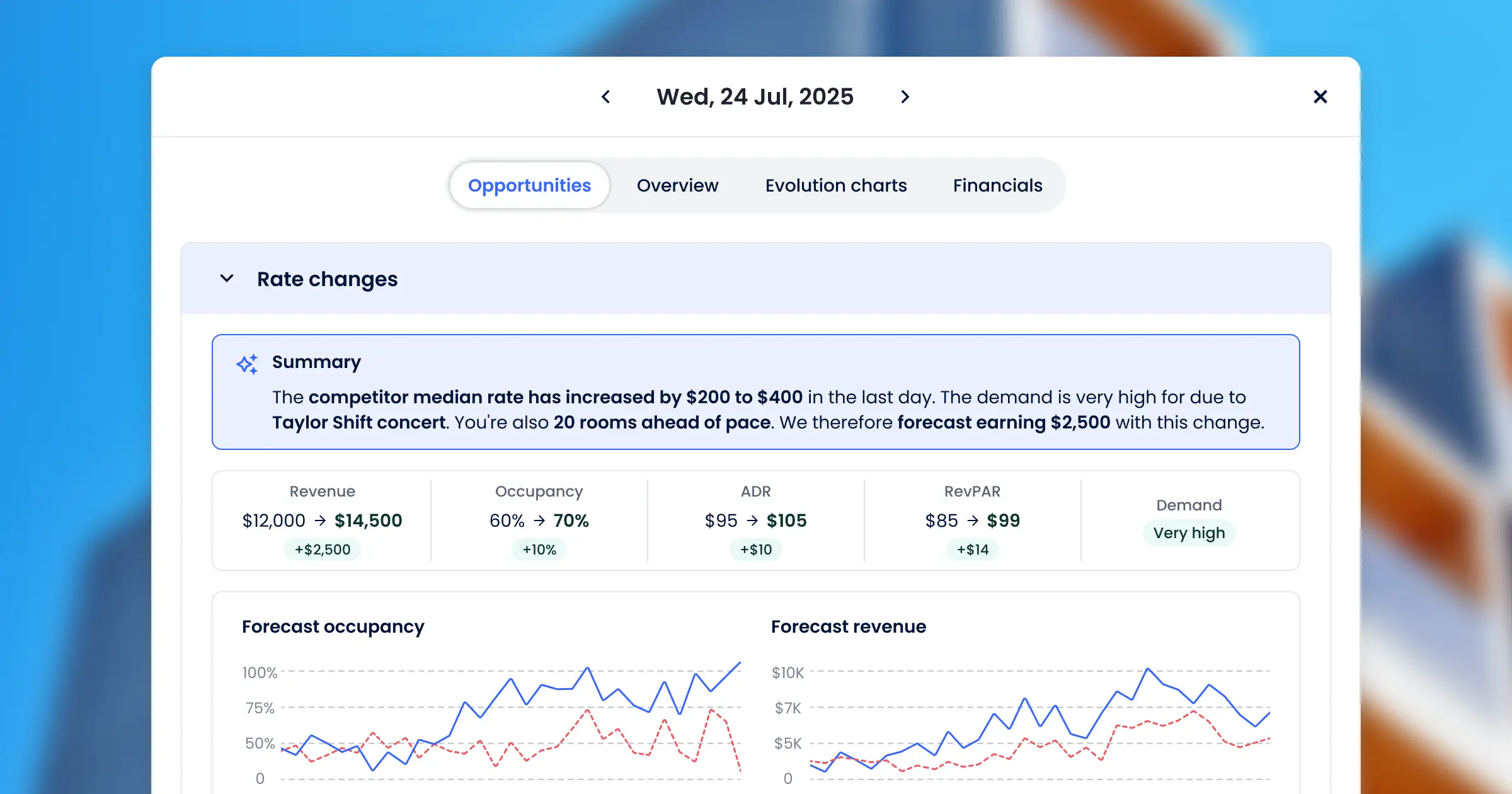
Cloudbeds Revenue Intelligence is a revenue management solution powered by a proprietary causal AI engine, natively integrated within the Cloudbeds platform. Forecasting demand up to 90 days out with up to 95% accuracy, it automates pricing decisions using real-time data — market trends, competitor rates, local events, and occupancy shifts — while reducing forecast error. The result: faster, smarter recommendations that adapt instantly to changing conditions and drive more revenue with less guesswork.
Properties using Cloudbeds Revenue Intelligence have the potential to increase RevPAR by 18%. When combined with Cloudbeds Guest Marketing CRM, it connects pricing strategy directly to demand generation, a unified approach called Revenue Marketing.
Cloudbeds Revenue Intelligence provides a robust, real-time understanding of all revenue aspects of the hotel. In today’s difficult climate, it’s essential to react quickly to market changes, and Cloudbeds Revenue Intelligence helps hotels do just that.
Forecast with up to 95% accuracy.
Move faster than ever before with Cloudbeds Revenue Intelligence.
Atomize
Atomize is a fully automated revenue management system that updates room pricing in real time without requiring manual input. Using AI to process large volumes of market data, it continuously recalibrates rates to reflect current demand — making it a strong fit for independent hotels and mid-scale properties that want intelligent automation with minimal configuration.
BEONx
BEONx is a total profitability platform that goes beyond revenue management to total profitability. Their AI-driven platform makes it easy for hoteliers to shift from RevPAR to RevPAG, optimizing guest journeys and the bottom line.
Beyond
Beyond is a revenue management solution for short-term rental managers and owners. Its platform includes a dynamic-demand-driven pricing tool with extensive market data that pairs with OTA distribution channels and booking engines.
Diamo
Diamo is an intelligent, all-in-one automated hotel revenue management system that maximizes RevPAR, so hotels can run with ease.
Duetto
Duetto is a cloud-based revenue management platform built for enterprise hotels and groups. Its Open Pricing model allows hotels to set rates independently across segments, room types, and channels — removing the traditional rate fencing constraints that cap revenue potential. Duetto is widely used by major hotel brands and management companies looking for sophisticated, scalable pricing tools.
FLYR
FLYR for Hospitality, an AI-powered decision and business intelligence suite, puts the power of machine learning and data science into the hands of managers.
Hotelitix
Hotelitix identifies revenue-generating opportunities in real-time, forecasting the exact price changes your hotel should be making to maximize performance.
IDeaS
Combining industry knowledge with innovative data analytics and AI, IDeaS creates sophisticated yet simple ways to empower hoteliers with precise, automated pricing they can trust.
Lighthouse is the leading commercial platform for the hospitality industry that transforms complexity into confidence with actionable market insights, business intelligence, and pricing tools that maximize revenue.
LodgIQ
LodgIQ is an adaptive revenue optimization platform that uses BigData Analytics and AI to forecast demand and price hotel rooms.
PriceLabs
PriceLabs is a revenue management solution that combines human control with automation and market data to maximize revenue. It uses automation rules and customizations to manage pricing and minimum-stay restrictions for larger portfolios to help property managers increase revenue.
Pricepoint
Pricepoint is a real-time price optimization engine that analyzes the market and updates room prices to keep you ahead of the curve and in front of competitors.
RateGenie
RateGenie aims to empower businesses with the data and insights needed to maximize their revenue through flexible and dynamic pricing strategies tailored to the needs of each property.
Rate Quantum
Rate Quantum is a revenue management system that uses science, AI, and the latest technology to determine the correct rates for your hotel.
RevControl
RevControl is a revenue management software that provides hoteliers with an intuitive platform to optimize revenue and deliver exceptional guest experiences.
Revolution Plus
Revolution Plus is a sophisticated revenue management system designed specifically for the hospitality industry. This AI-driven platform enhances your hotel’s sales and pricing strategies by analyzing extensive historical and real-time data from multiple sources.
RoomPriceGenie
RoomPriceGenie is the easiest way to ensure that your rooms are priced right every night. Purpose-built for the independent hotelier, RoomPriceGenie is fast to implement, intuitive to use, and simple to understand.
Smartpricing
Smartpricing is an RMS that manages the price of accommodation facilities and monitors hotel and market data. It uses smart algorithms to generate the most profitable rate based on current market demand, availability, and trends.
Turbosuite
Turbosuite is a revenue management system that covers revenue to account management to ensure the highest possible income to achieve economic sustainability in the hotel and vacation rental industry.
Already using an RMS you love?
No problem. Cloudbeds integrates with leading RMS providers.
Do I really need a revenue management system?
This is a question worth asking honestly, and the answer for most properties is yes. Here’s why:
Competitive pricing has never mattered more
Price is now one of the primary factors in a traveler’s booking decision, and travelers have more tools than ever to comparison shop across channels. An RMS ensures you’re never priced out of the conversation and are never leaving margin on the table during high-demand periods.
Markets are changing fast
Updating rates weekly, or even daily, is no longer enough. Demand signals shift hourly — events are announced, flights are booked, competitors adjust — and your pricing needs to keep pace.
The data you need is already there — it just isn’t connected
Your PMS, channel manager, and OTA data collectively contain powerful pricing signals. An RMS is what turns that fragmented data into revenue management strategies you can actually execute across all your distribution channels, from direct bookings to OTAs.
You don’t need a revenue manager to use one
Many of today’s platforms are built specifically for smaller teams or owner-operators. The right provider will offer onboarding and 24/7 support so your team is never left guessing. The automation does the work, you just set the boundaries.
Hotel tech is evolving fast
The gap between properties using intelligent pricing tools and those still on spreadsheets is widening every year. An RMS is no longer a feature of well-resourced enterprise hotels. It’s the baseline for any property serious about revenue growth.
Key features to look for in an RMS software
Not all systems are built the same. Your choice will depend on your property size, team setup, and budget. Here are the features that matter most:
Automated rules and alerts
To minimize time spent in the system, look for an interactive RMS that can support preset rules, alerts, and workflows so that you don’t have to check your data and update rates manually. Specific rules and alerts can include (but aren’t limited to):
- Compset-based alerts: get alerted anytime there is an important shift in pricing (i.e., be alerted every time your compset pricing goes up by 10%)
- Occupancy-based alerts: get alerted when it’s time to update your rates based on your occupancy (i.e., increase your rates when your occupancy rises).
- Restriction-based rules: add restrictions that stop you from receiving new reservations (i.e., minimum length of stay).
Rate comparison functionality
Maintaining rate parity is crucial as travelers frequent metasearch websites to compare pricing across a hotel’s distribution channels. Your RMS should have rate comparison functionality that allows you to view your rates across your booking engine, online travel agency connections (OTAs), and against competitors.
Forecasting and pricing recommendations
Based on factors like market demand, historical data, and competitor pricing, your RMS should be able to forecast and provide pricing recommendations to ensure you always offer the right price at the right time. You should be able to assign the level of control your RMS has in implementing pricing decisions by setting rules where your price is automatically updated in certain instances, and in others, it must have your permission.
We’re speaking to countless general managers and revenue managers. They’re spending so much time firefighting that they don’t have time for that high-level strategic outlook.
Comprehensive dashboard with key reports and insights
Data is of no use unless it can be analyzed and interpreted for decision-making. An RMS should provide key reports that offer an easily digestible snapshot of a hotel’s performance with the option to dig deeper into the data. Your RMS should give user-friendly insight into KPIs like RevPAR, TRevPAR, room nights sold, ADR, occupancy rate, booking sources, etc.
PMS and tech stack integration
An RMS in isolation is far less powerful than one deeply connected to your channel manager, PMS, CRM, and booking engine. Your systems need to communicate continuously, updating rates across channels, tracking available inventory, and feeding data for forecasting. Tight integration also improves operational efficiency across your whole team.
Cloud-based architecture
Real-time market monitoring requires real-time connectivity. A cloud-based RMS allows you to log in from anywhere, keeps your integrations live, and ensures you’re always running the latest version.
A provider with 24/7 support
Your room rates are the lifeblood of your business and the number one revenue driver. If you have a problem with your RMS, you need a partner with customer support resources available at all times to help get you back on track.
The right tech makes a difference.
See what features & functionality to look for in your next RMS.
8 benefits of using a hotel revenue management system
Let’s break down the benefits of using a revenue management tool in the hospitality industry.
1. Complex calculations, done fast
RMS algorithms work around the clock, processing thousands of data points to surface pricing recommendations your team couldn’t replicate manually.
We’re processing over four billion hospitality data points per hour, and we’re seeing up to 95% forecast accuracy over a three-month window – even 97% for some properties.
2. Smarter pricing decisions, every time
Without an RMS, pricing decisions often come down to instinct or habit. With one, every recommendation is backed by live market data, so you can price with confidence, not gut feeling.
3. Maximize revenue and RevPAR
Hotels using RMS technology report significant RevPAR gains. At the higher end, properties like Mercure London Paddington — using AI-powered Revenue Marketing — achieved 93% occupancy against a 64% competitor average, and outperformed the market RevPAR benchmark by £41 per available room.
93%
occupancy (against 64% compset)
4. Give your revenue manager more leverage
An RMS doesn’t replace revenue managers; it elevates them. By handling routine analysis and rate updates, it frees your team for higher-value work: strategy, segmentation, and identifying growth opportunities that data alone can’t surface.
HSMAI found that revenue managers spend 30% of their time convincing stakeholders to align with pricing strategies. With an RMS providing clear, data-backed recommendations, those conversations become faster, more aligned, and far more actionable.
5. No revenue manager? No problem
For smaller, independent properties, an RMS is the closest thing to having a revenue expert on staff. Most platforms are designed to be accessible to anyone responsible for pricing.
6. Keep a closer eye on your competitive set
Knowing what competitors are doing is table stakes in modern hotel pricing. An RMS surfaces compset rate changes automatically so you can respond strategically, not reactively.
7. Improve the guest experience
When your team isn’t buried in manual pricing tasks, they have more time for what matters: refining upsell strategies, identifying ancillary revenue opportunities, and delivering the kind of experience that earns repeat visits and five-star reviews.
8. Automate to offset labor pressures
More than 79% of hotels are unable to fill open positions. Revenue management is one of the most automatable functions in hotel operations — and one of the highest-leverage areas to start. An RMS helps ensure that resource allocation and inventory management happen correctly, even when your team is stretched.
79%
of hotels are unable to fill open positions
How do I choose the right revenue management system for my property?
There’s no single “best” RMS, only the best one for your specific situation.
Here’s how to think through the decision:
Property size and complexity
For smaller independent properties, a lightweight, intuitive standalone RMS or a native solution built into your PMS may be all you need. Larger hotels and multi-property groups typically benefit from enterprise-grade platforms that can handle segmentation, portfolio-level reporting, and complex rule sets.
Your team setup
Does your property have a dedicated revenue manager, or does your GM handle pricing alongside a dozen other responsibilities? If it’s the latter, prioritize automation and ease of use over advanced configuration options. The best RMS for a solo operator is one that runs intelligently in the background, surfacing recommendations without demanding constant input.
Integration requirements
Your RMS is only as powerful as its connections. Before evaluating any system, map your existing tech stack — PMS, channel manager, booking engine, CRM — and confirm compatibility. A native, PMS-integrated RMS eliminates the integration layer entirely and gives you cleaner, faster data flow.
Level of automation needed
Some teams want full automation: rates update without review, rules trigger without approval. Others prefer a recommendation-first approach where humans make the final call. Most modern RMS platforms offer a spectrum, therefore, you should decide where your team sits before you start evaluating.
Total cost of ownership
Consider not just the subscription cost but implementation, integration fees, training time, and ongoing support. A cheaper standalone tool that requires significant setup and manual maintenance may cost more in the long run than a natively integrated solution that’s ready on day one.
The right RMS is the one your team will actually use — consistently, confidently, and without needing a manual nearby.
Hotels of all shapes and sizes are getting sharper about revenue management. The global hotel revenue management market is growing at a pace as AI and automation make the technology more accessible, and the performance gap between properties using RMS and those still on spreadsheets continues to widen.
The properties winning on RevPAR today aren’t necessarily the biggest or best-funded. They’re the ones making faster, smarter decisions with better data. An RMS is no longer a luxury for enterprise chains; it’s the foundation of any modern pricing strategy.
The question isn’t whether you need one. It’s which one will take you furthest?
Key takeaways
- RMS tools adjust rates in real time based on demand signals you can’t track manually
- Independent hotels are feeling the pressure, with ADR down 5.8% and RevPAR down 5.4%
- The best RMS platforms combine PMS, competitor data, events, and market trends to forecast demand before it materializes
- Nearly half of hoteliers expect revenue management to be largely automated within five years
- Revenue managers are spending 30% of their time aligning stakeholders
- Integrated RMS solutions eliminate siloed data, giving teams a unified view across pricing, performance, and distribution
- Even small teams can run sophisticated pricing strategies without hiring a dedicated revenue manager
- Hotels using RMS technology consistently outperform those relying on spreadsheets
Built for hotels that demand more.
Put an end to expensive surprises with Cloudbeds Revenue Intelligence.